Monday, 28 November 2011


Tuesday, 15 November 2011


Abra(m/aham!) - a brief summary!
By the time we get to Abram, the situation is looking pretty bleak! Genesis 3-11 show the snowballing affects of sin, which even God's intervention through the flood - and removing the worst 99.9% of the "sinners" - fails to halt. By Gen. 11 the people are so powerful, and presumably not in a good way, that God decides to scatter them. Then, as is often the case in the Bible, it is time for a seemingly random genealogy - of the line of Shem (one of Noah's sons)! This genealogy is significant, however, for, as Tim Keller argues in his talk "Real Security and the Call of God," it suggests that the line of Shem is the only family line that has maintained the knowledge and worship of the one true creator God.
However, by the end of this genealogy, there are (again as Keller notes) some indications that even this family may now be turning away from worshipping God to worship idols. Firstly, Terah's name means "moon," suggesting that the moon was their idol of choice! Secondly, in Gen. 11:31, we see that the whole of Terah's family started out to go to Canaan, but stopped in Haran. These suggestions that something is amiss are then confirmed in Joshua 24:2, where Joshua reminds the Israelites that even their ancestors, Terah and Abram, worshipped other gods.
And then, into this seemingly hopeless situation - where even the one family that had preserved the knowledge of God seems to be turning away from him - God makes a call! He calls one man - Abram - to leave his now idolatrous family and set out for the land God would show him.
Now, it perhaps seems a bit strange that God just calls one man! In the creation account we saw something of the incredible power of God, whereby he just speaks and all things come into being. So why doesn't he just boom down in a loud voice - "STOP WORSHIPPING THOSE IDOLS, I'M THE ONE TRUE CREATOR GOD, COME AND WORSHIP ME!" Surely if he did then everyone would have listened and obeyed, they'd have been far too scared not to!
However, the creation account also revealed to us that God is not only powerful, but that he is also loving and that out of his love he grants people the freedom to either follow him or reject him. You see, the snake has no qualms about trying to extend his limited power through deceit and manipulation; but God will do no such thing! In fact, here in Gen. 12:1 we see quite the opposite as God withholds his limitless power in order to allow people the freedom to carry on rejecting him - and so God calls; he does not control.
God then makes a whole load of amazing promises - that Abram would be a great nation, that he'd get a land, that he'd be blessed and that he'd be a blessing to others. These are promises that God reiterates and expands on throughout the following chapters: promising to be Abram's shield and reward; promising him and heir and, most importantly, promising to be God to him and his descendants! God also changes Abram's name to Abraham to indicate that he will be the father of many nations. Moreover, God seals up all of these promises by a ritual that seems bizarre to us, but that was a common covenant making method in those days! God asks Abraham to cut a cow, a ram and a goat in half and then, as darkness fall, a burning pot passes through the middle of them; Abraham, however, does not go through. And so, God makes a covenant with Abraham that only he commits to! Thus God literally swears on his life that these promises will be fulfilled but Abraham doesn't have to swear to anything.
Through this covenant we see that just as God does not control, so too will he not be controlled! Now this may seem like an obvious statement, but in comparison to the surrounding nations it was actually quite radical. You see, in these nations, although the gods were unpredictable, there was also the belief that – by performing certain rituals and rites – they could be induced to do human beings bidding; thus, to an extent, controlled. For example within Canaanite religion it was thought that if a farmer had sex with a temple prostitute it would induce the gods to have sex and so produce more fruitful crops! (Drane, 83) The God of Abraham, however, will not be controlled by human beings – he is not induced by some magical rite or moral act to initiate this covenant with Abraham; he chooses to do so out of his own initiative and freedom. Further, he sets the terms and is the only one to commit to its fulfilment!
Nearly 25 years have gone past since God first called Abraham, and no heir has appeared! Abraham has, in the meantime, taken the matter into his own hands and produced an heir through his maid Hagar (so God had to come again and make it explicit that the heir would be through Sarai - or Sarah as God now calls her!). He has also told half-truths (thus half-lies) on two occasions about his wife Sarai being his sister because he was afraid he'd be killed if people knew she was his wife.
Then, finally, Sarah does become pregnant and gives birth to Isaac whereupon, some time later, God asks Abraham to sacrifice him!
Now, this can be a stumbling block for many of us in our reading of the Bible as it seems such an outrageous thing for God to ask someone to do. What we have to bear in mind, however, is that child sacrifice was a common practice in those days - and something God later reveals that he hates passionately. And so God doesn't ask Abraham to do something completely outside of his realm of experience, as it would seem to us. Rather, he uses what was commonly thought of as being the greatest sacrifice you could make to a god and asks Abraham to do that. What is therefore shocking about this story (from the point of view of someone living in Abraham's day), is the fact that Isaac isn't actually sacrificed; that there is a substitute, in the form of a ram, which is sacrificed instead.
Within all of this, we learn a lot about faith. Abraham is viewed by the NT as having legendary faith; he is the ultimate icon and example of faith! And we see through his willingness to leave the security of his family (literal security - there was no police force at that time to keep law and order, your clan was your protection!) that he had a faith that was active and which transformed the whole course of his life.
Further, however, we see on a number of occasions that his faith wasn't perfect. In Gen. 12 we see him go from meeting with God and receiving great promises to fleeing to Egypt to escape a famine and then lying by implying that Sarai wasn't his wife! And yet his imperfect faith was still counted as faith in that his overall orientation was towards God; ultimately, that's where his security and hope lay.
Thirdly, by the time we get to the end of Abraham's life, we see that not many of these promises have, as yet, been fulfilled! He has an heir - Isaac - and, in Gen. 23, buys a field with a cave in it, within which to bury Sarah. So out of the whole of Canaan, which God had promised him, he owns a field and a cave! And so we see that faith is intrinsically connected to hope. Or as the writer of Hebrews puts it:
"Faith is confidence in what we hope for and assurance about what we do not see. This is what the ancients were commended for."
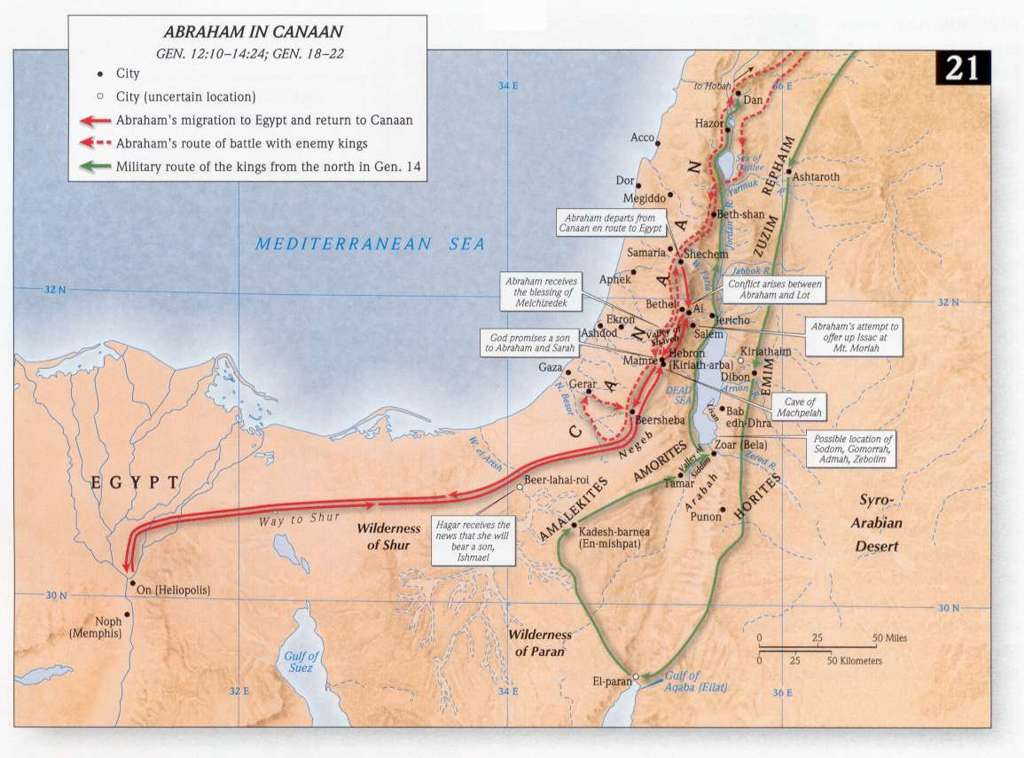
From: http://www.swartzentrover.com/cotor/bible/Bible/Bible%20Atlas/021.jpg
For a copy of the talk for this week click here!
For a copy of the talk for this week click here!
Tuesday, 1 November 2011
Gen. 1 & 2 - Creation!!!

Oh wait! Wrong creation account - let's try again!

Okay, so it was a deliberate error but what I've summarised first (v. briefly) is a Babylonian creation account that was around at the time many people think the Genesis account arose. If you read this myth in more detail (Enuma Elish), you'll see that there are some similarities. For example, in both accounts the separation of the waters is very important; further, the Babylonian myth is written on 6 tablets (cf. God creating everything over 6 days). Some scholars have, in the past, tried to claim from these similarities that the Genesis account was copied from the Babylonian one.
However, as a theologian called John Drane (p. 262) has pointed out, these similarities are superficial and based on a common cosmology (see also Hoffmeier p. 48). More significant, is the fact that, if there is any link between the two, then the Genesis account appears to deliberately undermine its Babylonian counterpart in significant regards. For example, in the Genesis account:
1. There is no conflict over who is the chief God - God just is! He has no rival!!!
2. God is separate from creation and resides over it; he is not mingled in with it as in the Babylonian account. Further, he is both transcendent in power (see Gen. 1) and intimately imminent (see, in amazing contrast, Gen. 2 & 3!!!) - he is not uncaring and removed.
3. Creation is not the haphazard result of conflict, rather it is deliberate, ordered and good.
4. People are fashioned in God's image as God's representatives and stewards on earth, rather than fashioned from a god's dead corpse and simply assigned menial tasks.
5. God is trustworthy and his actions are just and fair; he is not capricious and unpredictable as the gods are in the Babylonian account. Drane, p. 263: "the destiny of people is in the hands of a loving and personal God, and not n the control of either nature of superstition."
(Quick note about links! I'll be putting a few external weblinks on this blog, which is because I think they might be helpful - but it doesn't mean I agree with everything that's on them!!!)
Gen. 3 - The Fall

"What is Sin?" - see Through the Bible with Miss Happy and Friends!
"What are the Consequences of Sin?"
Well firstly, and ironically, the fruit which seemed to promise the knowledge of good and evil, actually distorts Adam and Eve’s perception of good and evil!
Thus, rather than seeing God as good and loving and someone to run towards; Adam and Eve start seeing God as someone to be feared and so hidden from. And so their relationship with God, which was previously so intimate that the God who made all things walked with them in the garden, is now torn. Importantly, though, we see God’s grace even at this early stage as he doesn’t simply abandon them, but rather clothes them.
Significantly, the other consequences of sin are all closely connected to the calling and privileged status God granted humanity in the first instance: so work, rather than being blessed and fruitful, will be hard and toilsome; child bearing – being fruitful in the reproductive sense – will be painful; and the relationship between men and women, rather than being empowering and helpful will become unequal and oppressive.
Gen. 6-9 - Noah

Sin snowballs! And so we see that just a couple of chapters on from Adam and Eve's rebellion, evil has entrenched itself into the hearts of humankind.
"...And the Lord was sorry that he had made humankind on the earth, and it grieved him to his heart."
All that God created was good, yet now it has become corrupted and damaged. Here we get an amazing insight into the effect that this corruption has on God: God mourns over evil; he mourns over the devastating effects that it has on people's lives; he grieves that what he intended to be so good has become so rotten and damaged. But what can he do about it?
"So the Lord said, "I will blot out from the earth the human beings I have created...together with animals and creeping things and birds of the air, for I am sorry I have made them."
God's grief over sin leads him to act. We've already seen in 3:22 that God has banned access to the tree of life which, as Jay B pointed out, is an act of grace as well as judgement (imagine living forever in a fallen world!). Now God is determined to wipe out the scourge of sin which, due to humanity's privileged status as God's stewards, has implication for the whole of creation - not just humans.
"But Noah...!"
Back in 5:29 Noah's dad, Lamech, had prophesied that Noah would bring relief from God's curses; now the favour he has with God sees the continuity of creation beyond the devastating flood. On this it's important to note:
1. Noah is called "righteous" and "blameless" even though we know from what ensues that he is not morally perfect! In the OT, just as in the New, righteousness is defined by faith - not moral perfection.
2. The role of a mediator arises again and again throughout Scripture. God is always looking for people with the faith to partner with him.
Then the flood comes, it stays around for quite some time, then finally it subsides. (NB. If you remember from the creation account a bit about Hebrew cosmology - watery chaos separated! - then you'll note that God sending a flood is significant for through it the world returns once more to the watery chaos from which order was brought. Thus the flood account acts as a kind-of anti-creation, a clearing of the Etch A Sketch (Rich H.!!!) so that things can start over again.)
Following the flood, God's instructions to Noah remain the same as they were at creation - be fruitful and be good stewards of the earth!
The Lord God then commits in his heart (8:21), and then to Noah (9:11), that he won't ever destroy all life again. So has the problem been solved? Has getting rid of the 99.999% of the worst sinners fixed the problem of sin?!
"...And Ham, the father of Canaan saw the nakedness of his father, and told his two brothers...Now the whole earth had one language...they said, "Come, let us build a tower with its top in the heavens..."...the Lord scattered them abroad over the face of all the earth...Then the Lord said, "How great is the outcry against Sodom and Gomorrah and how very grave their sin! I must go down and see whether they have done altogether according to the outcry that has come to me; and if not, I will know."..."
It appears not! Following the flood sin snowballs again. How will God deal with sin now? Well, we don't find out for a bit; but we do know that, in order to keep his promise, he'll need to find a way to destroy the sin without destroying the sinner!!!
Mr Evolution vs. Mr Creationist vs. ... !

Now by way of introduction, it is important to note that the word evolution can be used for anything from the process of natural selection - whereby animals/plants adapt to their local environment - through to the belief that everything evolved from one single-celled organism (thus man from monkeys...). Here, we'll be using evolution in the latter, more controversial, sense!
So, what is the disagreement between Mr Evolution and Mr Creationist and how should we respond? Well, in a massively simplistic way, the argument goes something like this:
Mr Creationist: "No, Mr Evolution, the Bible is the infallible word of God, so if it says that God created the world in 7 days then he did! You’re theory is wrong, your so-called evidence is flawed and the Bible is right!"
So how do we respond? Do we have to side with one or the other? Is it really a case of science vs. faith?
Well, we do also have a third option in the form of Little Miss Creatiolution (not a real word!). She would say something along the lines of the following:
Little Miss Creatiolution: "You see, the problem with Mr Creationist is the way he interprets the Bible. He comes to the Bible assuming that the writer of Genesis was as concerned with the scientific processes whereby the earth was formed as people are today whereas, in fact, the person who collated this account wouldn’t even have realised the world was round or that there was more of it than he’d heard of! Furthermore, Mr Creationist assumes that the writer intended to present historical facts, whereas actually he was simply presenting truth in the form of a meaningful myth. Mr Creationist is basically trying to force the Bible to answer questions it wasn’t addressing. In reality, the Bible simply answers the “why” question and evolution the “how” question; so we can hold our scientific views nicely alongside our faith by recognising that they simply answer different questions."
So what do we think? Little Miss Creatiolution seems to have found a way to hold science and faith nicely together (albeit in two different hands!) so is her view the best way forward? Or should we stick to the creationist view? Well, I'm going to let you decide that, but I would like to chuck in a few things for us to think about!
1. We can't take the Genesis account completely literally as Gen. 2 disagrees with Gen. 1 in terms of the order in which different things were made. Further, Gen. 1:1-2:3 is highly poetic whereas the account in Gen. 2 is much more story-like in style!
2. The theory of evolution is just that - a theory! Therefore even amongst scientists there is a range of opinions (see, for example, the Explore Evolution book and/or one of my favourite Friends clips!!!).
3. "Myth" isn't really the best word to use when talking about the Genesis account because, although technically it can mean a story which expresses truth, most people see a myth as simply a made-up story - perhaps with an accompanying moral. John Drane, for example, therefore suggests that the term "faith-story" is more appropriate (see Drane, Introducing the OT, page 265).
4. Although Gen. 1-3 is often viewed as a "faith-story" rather than a literal historical account, when we come to the Flood in Gen. 6 and Tower of Babel in Gen. 11, we find that there is archeological evidence to suggest that these accounts are based on historical events (see Drane, Introducing the OT, page 262).
5. As Little Miss Postmodern (see session 1!) has helpfully pointed out, the divide between faith and science is not so clear cut as people once thought! For example, scientists don't approach science neutrally or objectively, but rather in a certain way based on their perceptions of what is and isn't scientific!!! Further, just as a person's world-view affects their approach to science; so too does science affect people's world-view. Thus, for example, the theory of evolution (in its everything evolved from a single-cell form!) has a world-view attached to it that does appear to contradict the biblical account in a couple of significant ways. Firstly, within evolution, creation comes through death rather than being the deliberate work of God and instantly declared "good!" Secondly, humans are a slightly more advanced animal rather than set apart as made in God's image thus stewards of creation. Now, this is not to say that as Christians we can't believe in evolution as an answer to the "how God made the world" question. But rather that, if we do, then we do need to think carefully about how to reconcile this view with a commitment to the truth of Scripture.
Tuesday, 18 October 2011
The Bible vs. Mr Modern vs. Little Miss Postmodern!
A little bit about modernism and postmodernism and how these cultural/philosophical movements have influenced the way we go about interpreting the Bible.

- this recording is very quiet so to hear it you'll probably have to listen through headphones! -
(Quick disclaimer - this is admittedly simplistic!!! Plus, the argument isn't that we've bought into either of these movements wholesale but rather that we're inevitably influenced by the culture around us and these are both significant trends!)
Some help from history...
A quick look back at how people have gone about interpreting the Bible in the past and what we can learn from them to help us today.


- this is quiet so you may need headphones in order to hear it! -
- this follows on from The Bible vs. Mr Modern... -
- this follows on from The Bible vs. Mr Modern... -
(Disclaimer - there's a lot more to it than this but I've just picked out some highlights/made sweeping generalisations for the sake of simplicity!)
For a far more comprehensive and precise summary read Alister McGrath, Christian Theology: An Introduction.
Subscribe to:
Posts (Atom)